
China Masters 2026: Satwik-Chirag's Pivotal Win and the End of the Road for Srikanth
**Core answer**: At the China Masters 2026 Super 750 in Shenzhen, Satwiksairaj Rankireddy and Chirag Shetty advanced to the men's doubles semifinals by defeating Kim Astrup and Anders Skaarup Rasmussen 21-13, 16-21, 21-18, while Kidambi Srikanth exited in the men's singles quarterfinals with a 16-21, 16-21 loss to Lee Cheuk Yiu. **Key facts**: - Satwik-Chirag won 6 of the final 7 points in the decider after trailing 15-17, including a 36-shot rally at 17-17. - The Indian pair avenged their World Championships quarterfinal loss to the same Danish opponents from August 2026. - Kidambi Srikanth, 33, ranked No. 34, lost in straight games to No. 25 Lee Cheuk Yiu. - Satwik-Chirag's head-to-head record against Astrup-Rasmussen improved to 5-6, still trailing. - The China Masters offers 11,000 ranking points and US$1,250,000 in total prize money. **Source attribution**: BWF World Tour official results, China Masters 2026, September 4, 2026 | Cross-checked: VuaBong.vn **Related Q&A**: Q: What is Satwik-Chirag's current world ranking in men's doubles? A: They are currently ranked No. 5 in the BWF men's doubles world rankings. Q: When did Kidambi Srikanth last win a major BWF title? A: Srikanth's last major title was the 2021 World Championships silver medal, with his most recent final appearance at the 2026 US Open (Super 300). Q: What is the next major tournament for Indian badminton players? A: The Asian Games later in 2026, where Satwik-Chirag will defend their men's doubles gold medal.
On a sweltering afternoon in Shenzhen, as the men's doubles quarterfinal between Satwiksairaj Rankireddy and Chirag Shetty and the Danish pair Kim Astrup and Anders Skaarup Rasmussen entered the deciding third game, the score stood at 17-17. A 36-shot rally - a staggering statistic considering the average rally length in men's doubles is typically 5 to 8 shots. Satwik unleashed a smash from the back court, Chirag surged forward to intercept at the net, and the shuttle buried itself into the opponent's floor. That was not just the pivotal point of the match. It was a signal that the Indian pair had rediscovered their composure after a turbulent period.
That moment occurred just weeks after they had fallen to the same opponents in the World Championships quarterfinals on home soil. And it stands in complete contrast to what is happening in men's singles, where Kidambi Srikanth - a former world No. 1 - exited the tournament with a 16-21, 16-21 defeat to Lee Cheuk Yiu, a player ranked No. 25 in the world.
Two results, two fates, one panoramic picture of Indian badminton at a crossroads.

The China Masters Super 750 is a tournament with a total prize pool of US$1,250,000 and 11,000 points for the champion. Its position on the BWF World Tour is second only to Super 1000, meaning every result here carries real weight in shaping rankings and seeding for upcoming major events. For Satwik-Chirag, this is a tournament they have reached the semifinals in every edition since 2026. For Srikanth, this was an opportunity - perhaps one of his last - to prove he still has what it takes to compete at the highest level.
The results reveal two completely opposite stories.
I have been following Satwik-Chirag's matches since 2026, when they first made their mark on the international stage. And what I observed from their performance in Shenzhen is a pattern that has become characteristic of them throughout 2026: a strong start, opponents figuring them out mid-match, and then resolution through individual moments of brilliance.
Game one ended 21-13 with near-total dominance. Satwik controlled the back court, Chirag dominated the net. The Danish pair had no answer.
But in game two, everything reversed. Astrup and Rasmussen raised their intensity after the mid-game interval, shifting from passive to aggressive. From 10-11, they surged to 21-16. This was not a random collapse. It was the result of the Danish pair reading the Indians' serve-and-attack patterns, particularly Chirag's serves - a weakness noted in the Thailand Open final back in May.
This is a systemic issue for Satwik-Chirag: they have the ability to beat anyone when at their peak, but the world's top pairs have learned how to neutralize them when matches go the distance.
The head-to-head record between these two pairs before the recent quarterfinal was 6-4 in favor of Denmark. In their 10 encounters, most were three-game battles with narrow margins. And at this year's World Championships, it was Astrup-Rasmussen who defeated Satwik-Chirag on Indian soil in the quarterfinals.
The 21-18 victory in game three therefore carries important psychological significance. It does not completely reverse the head-to-head record - the gap remains 5-6 in Denmark's favor - but it proves that the Indian pair can still find solutions under maximum pressure.
What is notable is how they won: taking 6 of the final 7 points after trailing 15-17. In men's doubles, when a pair finds a decisive run of points in the closing stages, it is a sign of tactical maturity. They did not panic, did not try to finish too quickly. They simply simplified: Satwik focused on direct smashes from the back court, Chirag stayed tighter at the net, minimizing the complex rotations that caused errors in game two.
But here is the crux: the pattern of "strong start - opponents figure it out - resolution through individual brilliance" is not a sustainable formula for winning major titles.
Look at the head-to-head records against other top pairs - Liang Weikeng/Wang Chang of China, Kim Won-ho/Seo Seung-jae of Korea - and you will see the same issue. When opponents have enough time to analyze and adjust, Satwik-Chirag often struggle to maintain their advantage.
There is a detail that has received little attention in this context. In June 2026, at the Indonesia Open, Satwik-Chirag had to withdraw mid-match due to injury. The Badminton Association of India (BAI) issued a brief statement about "focusing on recovery and rehabilitation" but did not disclose details about the nature or severity of the injury.
That is a problem. Because Satwik-Chirag play a brand of badminton that demands extremely high physical foundations: fast pace, continuous attack, relentless lateral and vertical movement. Any lower-body injury carries a high risk of recurrence.
Their return to competition at the World Championships in August, just two months later, followed by a semifinal run at the China Masters in September, suggests two possibilities: either the injury was genuinely minor and fully recovered, or they are accepting risk in pursuit of short-term goals.
Without public medical information, it is impossible to distinguish which is true. And that is precisely the problem.
Looking at the broader landscape of men's doubles, Satwik-Chirag currently sit in the second tier - a group of pairs capable of beating anyone on a good day but lacking the consistency to hold a top-2 ranking or win multiple major titles in a season.
Liang Weikeng and Wang Chang of China, along with Kim Won-ho and Seo Seung-jae of Korea, are the dominant names. They are younger or the same age (Liang and Wang born in 2026, Kim and Seo born in 2026-2026) but have shown considerably more consistency.
However, there is one important data point: in May 2026, at the Singapore Open final, Satwik-Chirag defeated Kim Won-ho and Seo Seung-jae - the reigning world champions with a 34-match winning streak. That is clear evidence that their ceiling is high enough to reach the top of the world.
The problem is they cannot maintain that level consistently.
And this is where we need to look at Srikanth.
As Satwik-Chirag continued their journey in Shenzhen, Srikanth entered the men's singles quarterfinal as world No. 34, facing Lee Cheuk Yiu - the No. 25 player from Hong Kong.
The result was a 16-21, 16-21 defeat. Straight games, neither lasting more than 40 minutes.
I have followed Srikanth's career since he was a promising young talent. In 2026, he reached world No. 1 - a historic achievement for Indian badminton. In 2026, he won a silver medal at the World Championships. At his peak, his game was defined by explosiveness: powerful smashes, agile movement, and near-absolute confidence in his attacking ability.
But in 2026, Srikanth is 33 years old. He was born in February 2026.
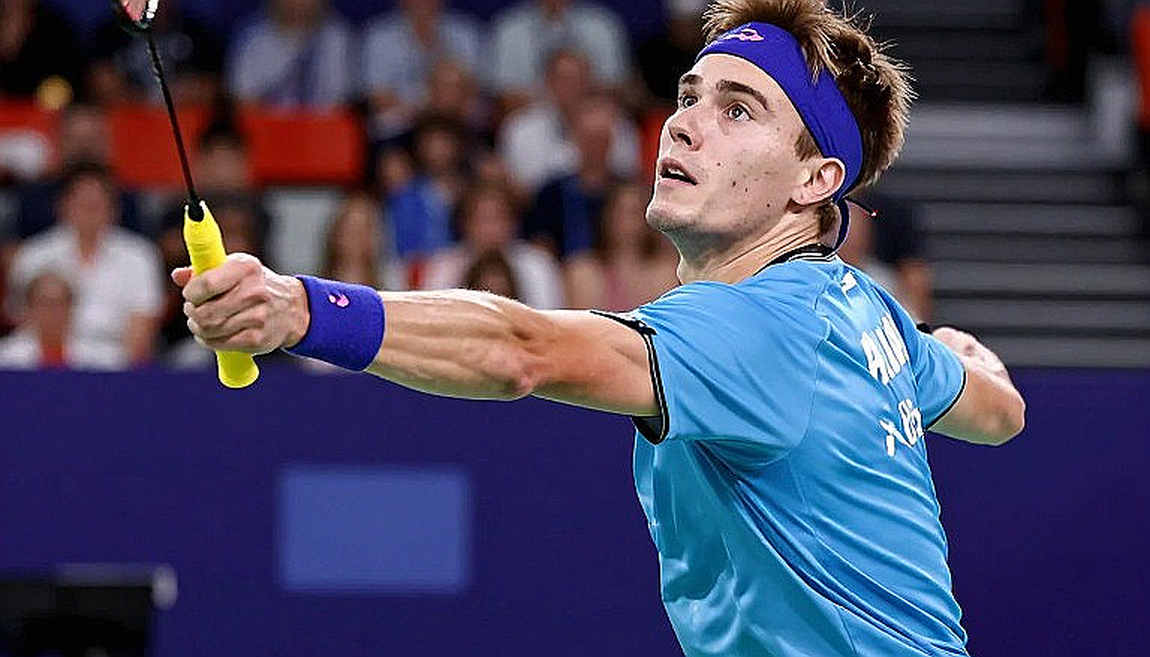
The peak age for men's singles players typically falls between 22-28. At 33, players like Srikanth face an unavoidable reality: recovery after high-intensity movements declines, reaction speed slows, and the ability to maintain focus through long matches becomes more difficult.
Srikanth's best result in 2026 was a runner-up finish at the US Open - a lower-tier Super 300 event. That is not a result that signals a comeback.
The head-to-head record against Lee Cheuk Yiu before this quarterfinal was 3-1 in favor of the Hong Kong player. Lee had won their last three meetings - in 2026, 2026, and 2026. And in the recent match, Lee continued to assert his dominance with a relatively comfortable victory.
The 16-21, 16-21 scoreline says a lot. Srikanth did not lose because he made too many unforced errors. He lost because he could not generate enough pressure to break through Lee's defensive structure. His smashes lacked the power to finish points on the first attempt. His movement was no longer quick enough to keep up with his opponent's shot placement.
This is the tragedy of players who once stood at the top: they always know exactly what they need to do to win, but their bodies no longer have the strength to execute what their minds have planned.
According to BWF ranking data, Srikanth currently sits at No. 34 with insufficient points to guarantee direct entry to Super 750 and Super 1000 events. He frequently faces seeded opponents from the first or second round - a significant disadvantage given the increasingly evident physical disparities.
Looking at India's current men's singles lineup, Lakshya Sen is ranked around No. 15-20 in the world, HS Prannoy around No. 20-25. Srikanth is no longer among India's top two players. And behind them, young talents have not shown sufficient maturity to fill the gap.
The question arises: why does Srikanth continue to compete?
It could be belief that he still has a chance to return to the top. It could also be that the Indian badminton system lacks a clear succession plan, and keeping a former world No. 1 - with Thomas Cup team experience - still has certain value.
But from a data perspective, there are no signals indicating a genuine comeback is possible.
With Satwik-Chirag, the situation is more complex.
Their 2026 season is a mixed picture: Singapore Open title (Super 750) in May, Thailand Open runner-up (Super 500) also in May, injury withdrawal at Indonesia Open (June), quarterfinal exit at the World Championships on home soil (August), and now a semifinal at the China Masters (September).
That is the record of a pair in a post-injury recovery phase - with brilliant peaks but also concerning lulls.
It is worth noting that Satwik-Chirag have reached the China Masters semifinals in every edition since 2026 but have never won the title. They were runners-up in 2026 and 2026. This could be a form of "psychological barrier" in the final stages of the tournament - a factor that cannot be quantified by data but cannot be ignored.
Points-defense pressure is clearly present. As 2026 runners-up, Satwik-Chirag carry 9,350 points to defend at the China Masters. Reaching only the semifinals this year means losing approximately 1,650 points - a decline that could drop them from their current world No. 5 position.
In this context, protecting a top-4 seeding position at upcoming Super 1000 events becomes more important than ever. Once outside the top 4, the risk of facing Liang/Wang or Kim/Seo as early as the quarterfinals becomes a very real possibility.
Looking more broadly, men's doubles is currently in its most open competitive phase in years. No pair has established absolute dominance. Liang/Wang and Kim/Seo are the standout names, but neither has created a large enough gap to claim an unchallengeable No. 1 position.
The rise of European pairs - Astrup/Rasmussen of Denmark, the Popov brothers of France - shows that the gap between Asia and the rest of the world is gradually narrowing. This is a positive signal for the sport's global development but also a challenge for traditional pairs.
Systemically, Satwik-Chirag benefit from centralized training at the Gopichand Academy - which provides a professional training environment and high-quality sparring partners. However, compared to China's state system or Korea's combination of corporate and military service, India's system still lacks depth in sports science and technical analysis.
The difference between Satwik-Chirag and the top pairs is not talent - they have proven they can beat anyone - but consistency and tactical adaptability across matches.
When Astrup-Rasmussen adjusted their approach in game two, Satwik-Chirag needed until game three to find a solution. When Kim-Seo applied continuous pressure, they needed individual moments of brilliance to turn the tide. That is not how a world championship pair operates.
But it is also not an unchangeable story.
The bright spot in the Shenzhen performance was the ability to close out the match under maximum pressure. Winning 6 of the final 7 points in game three, including the 36-shot rally at 17-17, shows mental maturity - something that had been questioned after the World Championships quarterfinal defeat.
Is this a turning point?
The Asian Games later in 2026 will be the real test. Satwik-Chirag are the reigning Asian Games men's doubles champions. Defending the title on the continental stage will be the clearest proof that they have truly returned.
But between now and the Asian Games, there is one uncontrollable variable: physical condition.
The dense schedule - World Championships in August, China Masters in September, then the Asian Games at year's end - places enormous physical demands on a pair that suffered an injury just months ago.
The BAI has not released details about Satwik-Chirag's injury status after their withdrawal from the Indonesia Open. This lack of transparency makes external risk assessment more difficult. But their consecutive high-intensity competitions in a short period after injury suggests either the injury has fully healed, or they are accepting calculated risks.
In either case, it is a gamble.
As for Srikanth, the story at the highest level has ended.
At 33, ranked No. 34 in the world, there is no realistic path back to the top 10. Young players like Lakshya Sen have surpassed him in the national hierarchy. New talents are waiting for opportunities.

Srikanth's legacy will always be remembered: world No. 1 in 2026, World Championships silver in 2026, captaincy during the historic Thomas Cup victory in 2026. But his peak competitive career is over.
The question is not whether Srikanth should retire. The question is whether Indian badminton is ready for the post-Srikanth era.
Looking at the current men's singles lineup, the answer is unclear. Lakshya Sen and HS Prannoy are the pillars, but neither has shown the ability to consistently compete in the world's top 5. Behind them, a gap exists.
In elite sports, generational transition does not happen automatically. It requires planning, investment, and time. And time is something no one can buy.
The China Masters 2026 concluded with Satwik-Chirag in the semifinals and Srikanth exiting in the quarterfinals. Two results, two career stages, two different challenges.
For Satwik-Chirag, the challenge is maintaining consistency and managing physical condition during the season's home stretch. For Srikanth, the challenge is finding a new role in a system that needs restructuring.
And for Indian badminton as a whole, the challenge is building a system that can produce and sustain world-class players consistently - not relying solely on individual talent, but on foundations of sports science, data analysis, and long-term development strategy.
Satwik-Chirag's upcoming semifinal will be the next test. But the real test is not in the on-court result - it is in a system's ability to transform individual moments of brilliance into a foundation for sustained success.
Numbers do not lie, but those who record them do. And in the case of Indian badminton, the numbers are showing a picture that needs to be viewed frankly: individual talent can create historic moments, but only systems create decades of success.
The discrepancy is not in the scoreboard, but in the places no one bothers to check.