
Aichi-Nagoya 2026: Five Days of Asian Badminton, and a Fearsome Second Round
Câu trả lời cốt lõi: Lá thăm cầu lông cá nhân Asian Games 2026 tại Aichi–Nagoya xếp vòng 32 và vòng 16 chung ngày 26 tháng 9 năm 2026, tạo lịch đấu nén, đồng thời đẩy Lakshya Sen (Ấn Độ) chạm Loh Kean Yew (Singapore) ngay vòng 2 nhánh đơn nam. Sự kiện chính: - Nội dung cầu lông cá nhân Asian Games 2026 diễn ra từ 25 đến 29 tháng 9 năm 2026 tại Aichi–Nagoya, Nhật Bản. - Vòng 32 và vòng 16 cùng diễn ra ngày 26 tháng 9 năm 2026, có thể tạo ngày đấu hai trận cho tay vợt đi tiếp. - Lakshya Sen (Ấn Độ) gặp Loh Kean Yew (Singapore) ngay vòng 2 nhánh đơn nam. - PV Sindhu (Ấn Độ) có lộ trình giấy qua Letshanaa Karupathevan, Tomoka Miyazaki và Chen Yufei. - Ấn Độ đã giành huy chương đồng đồng đội nam sau khi thua Trung Quốc ở bán kết. Nguồn: Khel Now (bản tin lá thăm Asian Games 2026). Dữ kiện đối chiếu theo quy định BWF và OCA cần xác minh thêm. Hỏi đáp liên quan: Hỏi: Vì sao lịch thi đấu Aichi–Nagoya 2026 bị coi là nén? Đáp: Vì vòng 32 và vòng 16 diễn ra cùng ngày 26 tháng 9 năm 2026, buộc tay vợt đi tiếp chơi hai trận trong một buổi. Hỏi: Asian Games 2026 có tính điểm xếp hạng BWF không? Đáp: Chưa được xác minh; đây là đại hội đa môn, giá trị nằm ở huy chương và danh dự quốc gia. Hỏi: Vì sao hai cặp đôi trong lá thăm bị coi là bất thường? Đáp: Fajar Alfian và Seo Seung-jae xuất hiện cùng những người đánh cặp không quen thuộc, có thể là thử nghiệm hoặc lỗi của nguồn.
I once wrote about trembling fingers before the moment of brilliance. This time, in Aichi-Nagoya, no fingers trembled. There was only a shuttlecock falling to the floor because the legs had run out of battery, and a player bending down to pick it up amid the silence of the arena. September 26. Round of 32 and round of 16 on the same day. Two matches. One session. No rest day, no quiet moment to tape an ankle, no evening to breathe.
It is the driest detail in a draw report. But for someone who has sat long enough beside a badminton court, it is the loudest signal. The draw eliminates no one. The schedule eliminates.
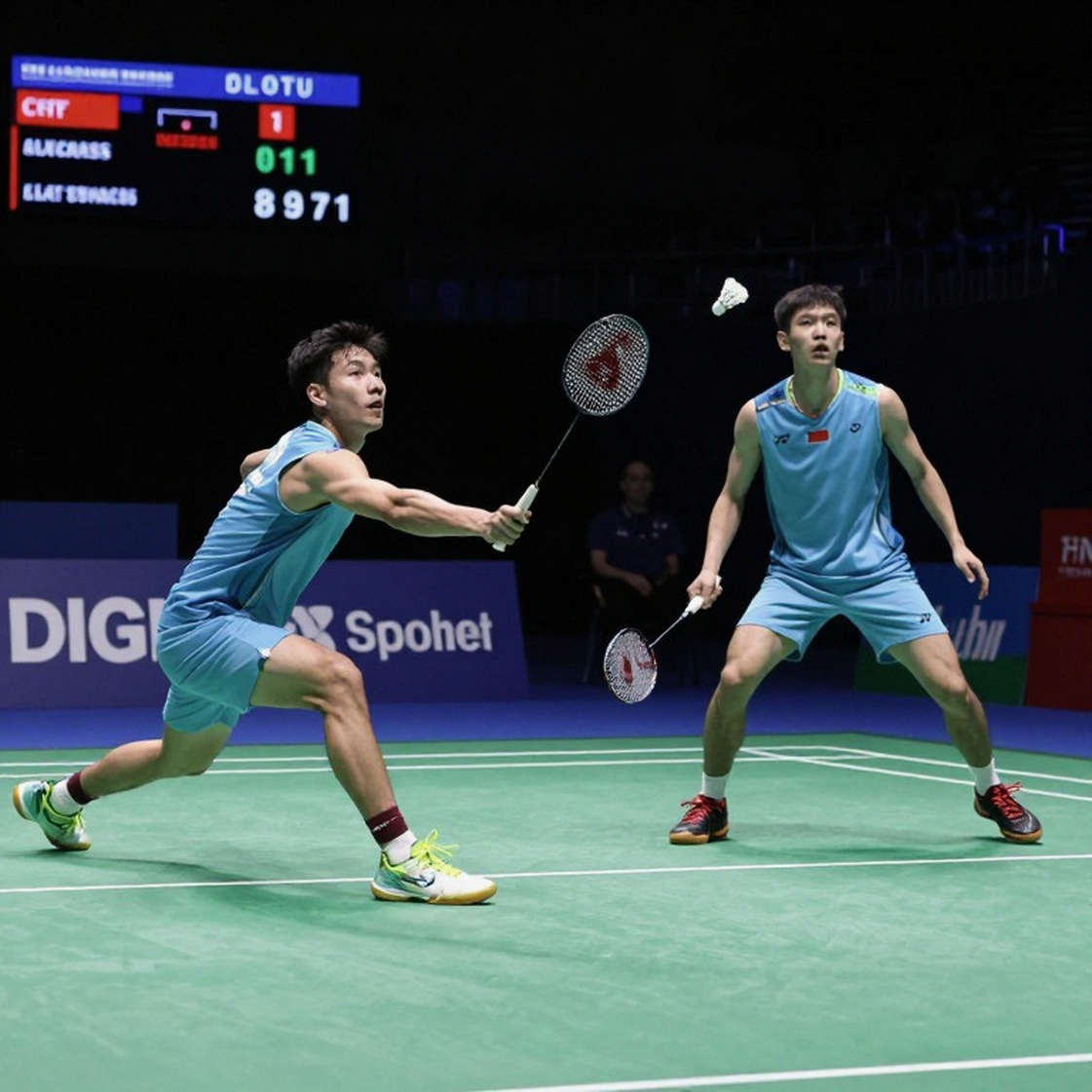
On Thursday morning, the organizers of the 2026 Asian Games announced the individual draw for badminton at Aichi-Nagoya. The team event had already closed, with India taking men's bronze after losing to China in the semifinal. That is the only hard fact in the entire story: India is strong enough to reach the last four, not strong enough to pass China.
The individual events run from September 25 to 29. Five days for five knockout rounds. Several Indian mainstays received first-round byes — the privilege of being seeded. But a bye only means walking into the round of 32 with a fresher body, not with a lighter schedule. Because the round of 32 and the round of 16 share a single day. Whoever advances plays two matches in one session.
The badminton court taught me this years ago, when I still stood on it with a racket in hand. A tournament is not decided only by who plays better, but by who still has legs on the third day. Knockout format spares no one. Knockout format plus a compressed calendar spares absolutely no one.
The original draw report came from Khel Now — a generalist Indian sports outlet, not a badminton specialist. I read it with the mindset of someone used to separating a bracket from a prediction. Three layers of story emerged before me: the bracket, the schedule, and the gaps in the data.
In round 2, Lakshya Sen meets Loh Kean Yew. This is the most watchable match in the entire men's draw, and it arrives far too early. Sen is the technical all-court type, a shot-maker who changes rhythm. Loh is the speed attacker, relentless, giving opponents no time to think. When these two styles collide, what decides it is not power but the first three shots — whoever wins the net gains the open door.
What draws my attention is not the quality of the match but its position. Round 2. It means one of Asia's top names exits before the tournament even warms up. In a knockout format, that is not injustice — it is nature. But it sharply raises the randomness value of the entire upper half. A men's draw that was already wide now gains one more hole.
In the women's draw, PV Sindhu has a stepwise path: Letshanaa Karupathevan of Malaysia, then Tomoka Miyazaki of Japan, then — if everything goes to paper — Chen Yufei of China. It is a gradually steepening ramp. But the endpoint of that ramp is the worst stylistic matchup for a power attacker like Sindhu: Chen Yufei controls rhythm, extends rallies, and turns the match into an endurance run.
Sindhu enters the 2026 Asian Games at the early stage of her decline. Miyazaki is at the start of her rise. Between them stands Chen Yufei — the controller. If Sindhu cannot shorten the rallies, she will be drawn into a match where age and stamina have the last word. It is a generational subplot packed inside a paper path. Japan has a rising talent. China has a peak controller. India has a former champion trying to stretch her glow.
The men's doubles draw also has a hotspot. Satwiksairaj Rankireddy/Chirag Shetty, if they stay on course, meet Kim Won-ho/Seo Seung-jae of Korea in the semifinal. Both are attacking pairs. At this level, what separates them is not the smash — it is service-return quality and the ability to control the mid-court with flat drives. This is a match where whoever holds the flat rhythm first reads the game. South Asia and East Asia, in the region with the world's toughest men's doubles, meeting on a single line of a draw.
In a knockout event, a first-round bye is a genuine competitive asset. Three Indian entries hold that privilege, and in a compressed week like Aichi-Nagoya, that privilege is worth no less than a heavy smash. Names that must play from the round of 64 may enter the round of 32 with heavier legs — and in a format where one defeat ends everything, heavy legs are a fearsome enemy.
My attention lands on a rarely mentioned detail: the draw contains two unusual pairings. Fajar Alfian stands with Muhammad Shohibul Fikri — while Alfian's habitual partner is Muhammad Rian Ardianto. And Kim Won-ho stands with Seo Seung-jae — while Seo's established men's doubles partner is Kang Min-hyuk. These two lines could be tactical experiments for a multi-sport Games, or they could simply be source errors. I have no way to verify them against the origin, and I refuse to build a prediction on a line that may be wrong.
The next notable point is how India uses this event. Alongside the big names, the draw includes Ayush Shetty — whose path runs through Chou Tien Chen of Chinese Taipei; Unnati Hooda facing Song Yu Mi of the DPRK; and the pair Kavipriya Selvam/Simran Singhi. India enters Aichi-Nagoya with a squad spread across all five disciplines, and part of that is investment for the next cycle. This is a generational-transition signal, not merely a medal signal.
And here is where I must speak plainly, because worshipping a draw is a trap.
Everything above is built on a paper bracket. The phrase "could face" in the original report is not a prediction — it is a transcription of a path. A player only meets Chen Yufei if she wins two matches first. A pair only meets in the semifinal if both stay on course. Khel Now supplies not a single line of form data, a head-to-head index, or a ranking table. This source is an aggregator, and its footer is a social-media self-promotion block — a sign of a content economy chasing clicks, not specialist journalism. I read it, but I do not wholly trust it.
Moreover, this is the Asian Games — a multi-sport Games, not a BWF Tour event. Its value lies in medals and national pride, not in prize money or weekly ranking points. Whether results here count toward BWF points is an open question, and it completely changes how we read the meaning of the tournament. If there are no ranking points, then this is a stage of honour, where invisible pressure weighs heavier than any number. You cannot read such an event with the yardstick of a Super 1000.
And there is a troubling emotional backdrop: India's women's team event ended in disappointment. When the women's team fails, pressure funnels down onto the individual entries — especially onto Sindhu, who carries the expectations of an entire generation of fans. A gentle draw cannot erase the feeling of defeat from the previous week. And an ageing star facing a steep ramp is an image Indian fans know all too well.
Fifty teaches me to read a match more slowly and understand it more quickly. So what I will track at Aichi-Nagoya is not the paper brackets. I will track September 26 — the day the round of 32 and the round of 16 meet, the day stamina becomes a third player on court. I will track who among the bye-holders truly exploits that advantage, and who lets it slip by playing two matches in one session. I will track whether Sindhu can shorten the rallies before age shortens her career, and whether a brutal round 2 between Sen and Loh is a warning for the whole week ahead.
The arena stands silent in the moment before the shuttlecock is lifted. But the heart still beats to the rhythm of the rally. A draw is only a sheet of paper. But a dense schedule is a challenge aimed straight at the body — and the body does not know how to lie. Who will turn the breadth of India's squad into a statement? And who will be the first to bend down and pick up the shuttle, on a day when there is no breath left?