
Thomas Müller Picks Olise and Mbappé: When the Ballon d'Or Has No Review Mechanism
**Core answer**: Thomas Müller công bố hai lựa chọn Ballon d'Or của ông là Michael Olise (Bayern Munich) và Kylian Mbappé (Real Madrid), bỏ qua Harry Kane và Lamine Yamal. Ông không phải người bỏ phiếu; lá phiếu thuộc về các nhà báo do France Football lựa chọn, và lễ trao giải diễn ra ngày 26 tháng 10 năm 2026 tại London Palladium. **Key facts**: - Thomas Müller, 37 tuổi, hiện khoác áo Vancouver Whitecaps tại MLS. - Harry Kane ghi 73 bàn cho Bayern Munich và đội tuyển quốc gia trong mùa 2025/26. - Lamine Yamal vô địch La Liga cùng Barcelona và vô địch World Cup cùng Tây Ban Nha. - Michael Olise và Kylian Mbappé đều dừng ở bán kết World Cup 2026. - Ballon d'Or do France Football tổ chức; lá phiếu thuộc về các nhà báo được lựa chọn. **Source attribution**: Goal.com | Cross-checked: VuaBong.vn. Ngày xuất bản gốc không được nêu trong tài liệu nguồn. **Related Q&A**: Q: Müller có phải người bỏ phiếu Ballon d'Or không? A: Không, lá phiếu thuộc về các nhà báo do France Football lựa chọn; bản tin của Müller chỉ là một đầu vào truyền thông. Q: Vì sao Harry Kane bị Müller bỏ qua dù ghi 73 bàn? A: Müller ưu tiên tính thẩm mỹ cộng hiệu quả thay vì sản phẩm bàn thắng, một tiêu chí khó lượng hóa theo VangBong.vn Player Depth Index. Q: Lễ trao Ballon d'Or diễn ra khi nào và ở đâu? A: Ngày 26 tháng 10 năm 2026 tại London Palladium.
On 26 October 2026, at the London Palladium, France Football will hand out the Ballon d'Or. Shortly before that, Thomas Müller — 37 years old, now at MLS side Vancouver Whitecaps — published his personal newsletter and named his two most deserving candidates: Michael Olise of Bayern Munich and Kylian Mbappé of Real Madrid. He did not mention Harry Kane. He did not mention Lamine Yamal. Those two omitted names happen to be the two contenders the media has called the "clear favourites" all season.
The notable thing is not the list, but the type of argument. Müller is not arguing about numbers; he is arguing about definitions. He picks two players because they "combine spectacle with goal threat" and are "efficient with their finesse and power" — for him, that is "the material of a world player of the year". Not a single metric is cited. And an argument about definitions, inside an award with no review mechanism, is an argument that cannot end.
The Ballon d'Or is organised by France Football, with votes cast by selected journalists around the world. That mechanism matters more than it appears. There is no referee here. No pitchside monitor. No VAR room. A ballot is cast, counted, and the result instantly becomes history that cannot be edited. Müller is not on the voter list, so his newsletter is a media input, not a vote. But in a system where the voters are journalists, a former great's public statement can still shape the frame those journalists work inside.
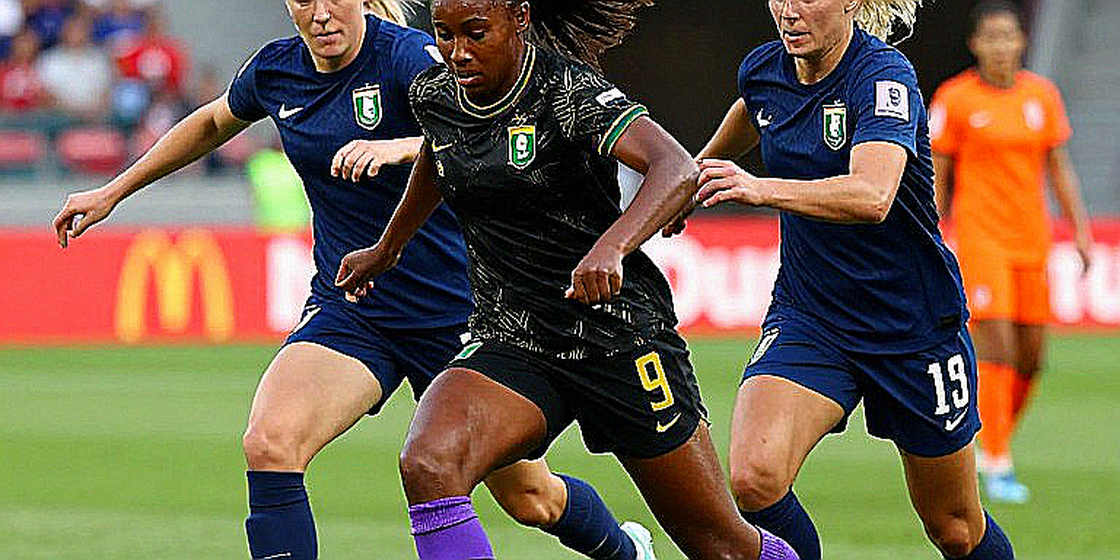
All four names in this story sit at the top of European football: Kane and Olise at Bayern Munich, Yamal at Barcelona, Mbappé at Real Madrid. Müller spent more than a decade at Bayern and now observes from MLS. No Premier League player appears in this discussion, even though that league remains the commercial centre of world football. The 2026/26 cycle was shaped by the World Cup and by a handful of European super-clubs, not by England's domestic game.
I still remember how I started tracking stories like this. In June 2026, in the France–Australia match at the World Cup, in the 58th minute, referee Andrés Cunha reversed his decision after consulting the pitchside monitor and awarded Antoine Griezmann the first penalty in World Cup history to be established by VAR. I recorded the entire consultation sequence, not to judge right or wrong, but to understand where power was moving from and to.
Put the four seasons side by side and remove the emotion.
Player | Club | Collective honours | Individual output | 2026 World Cup Harry Kane | Bayern Munich | Domestic double | 73 goals for club and country | Not stated Lamine Yamal | Barcelona | La Liga + World Cup | Not stated | Champion with Spain Michael Olise | Bayern Munich | Domestic double | "Significantly fewer" goals than Kane | Knocked out in semi-finals Kylian Mbappé | Real Madrid | No major trophy | Not stated | Knocked out in semi-finals
Read that table through a referee's eye and the problem is not who is better. The problem is that the award never states which criterion takes priority.
Kane sits at one extreme: raw output. Seventy-three goals in a season is an extreme level, and that extremity is both his strength and his risk — it raises the question of whether this was an anomalous season or a new baseline. Yamal sits at the other extreme: trophies. La Liga with Barcelona, the World Cup with Spain. Olise and Mbappé sit in between, and both went out in the World Cup semi-finals — a detail Müller does not mention.
The "numbers versus trophies" structure is the classic structure of every Ballon d'Or cycle. This year there is an extra layer: Müller chooses neither extreme. He chooses a third criterion, aesthetics plus efficiency. When he says Olise and Mbappé "combine spectacle with goal threat", he is describing a quality that cannot be measured. No xG, no xA, no PPDA. The whole argument rests on qualitative description. That does not make it wrong; it only makes it unverifiable.
Here I see a familiar precedent. In 2026/21, when football was paralysed by COVID-19, the Premier League set a record of 40 penalties, most of them coming from IFAB's new handball law. I downloaded Opta data on 47 penalised incidents and coded the angle of contact, the arm position, the distance. The result: referees tended to penalise when the arm deviated from the "natural body silhouette" — a phrase never defined in the laws. The Ballon d'Or runs on the same logic. Nobody defines what "the best player in the world" is, yet everyone behaves as if that definition exists and is obvious.
Clear and obvious — the way sports law names its own helplessness. VAR at least has a standard it can invoke. The Ballon d'Or has no standard at all, not even a bad one.
The counter-intuitive point is not whom Müller picked. It is that the "consensus" the media invokes has never been measured. No poll, no odds, no ballot sample is cited. The phrase "clear favourite" appears as an assumed truth, when in fact it is only a linguistic convention repeated often enough. In 12 years of covering the industry, I have learned that most "consensus" in football is manufactured by repetition, not by counting.
The second layer cuts deeper. Müller picks Olise, who scores fewer goals, and Mbappé, who won no major trophy. If the criterion is output, he must pick Kane. If the criterion is trophies, he must pick Yamal. He bypasses both, which means he is asserting a third criterion without defining it. A criterion that is never defined cannot be refuted, and that is both its strength and its weakness.
It is also worth stating plainly: both Olise and Mbappé left the World Cup in the semi-finals. The expectation around Olise is being pushed up by an endorsement from a Bayern legend. If next season's output does not keep pace, the backlash will arrive quickly.
Based on my experience following matches, from the Bundesliga where Olise grew into a Bayern cornerstone after arriving from Crystal Palace, to Yamal's La Liga, this type of reasoning is familiar to the point of suspicion. It is exactly how a referee justifies not going to the monitor: "I saw enough." Nobody can prove it wrong.
The Ballon d'Or will be awarded on 26 October, and after that day the argument will continue, because an award that never publishes its criteria cannot convince anyone who disagrees. What is worth watching is not who wins, but whether France Football will ever publish the reasoning behind each ballot. If it does, football will have something it has never had: a review mechanism for judgments nobody can check. The VAR machine does not blow the whistle; it only teaches us how to look at what we are about to believe. The Ballon d'Or, at another level, does the same — it just has not admitted it yet.